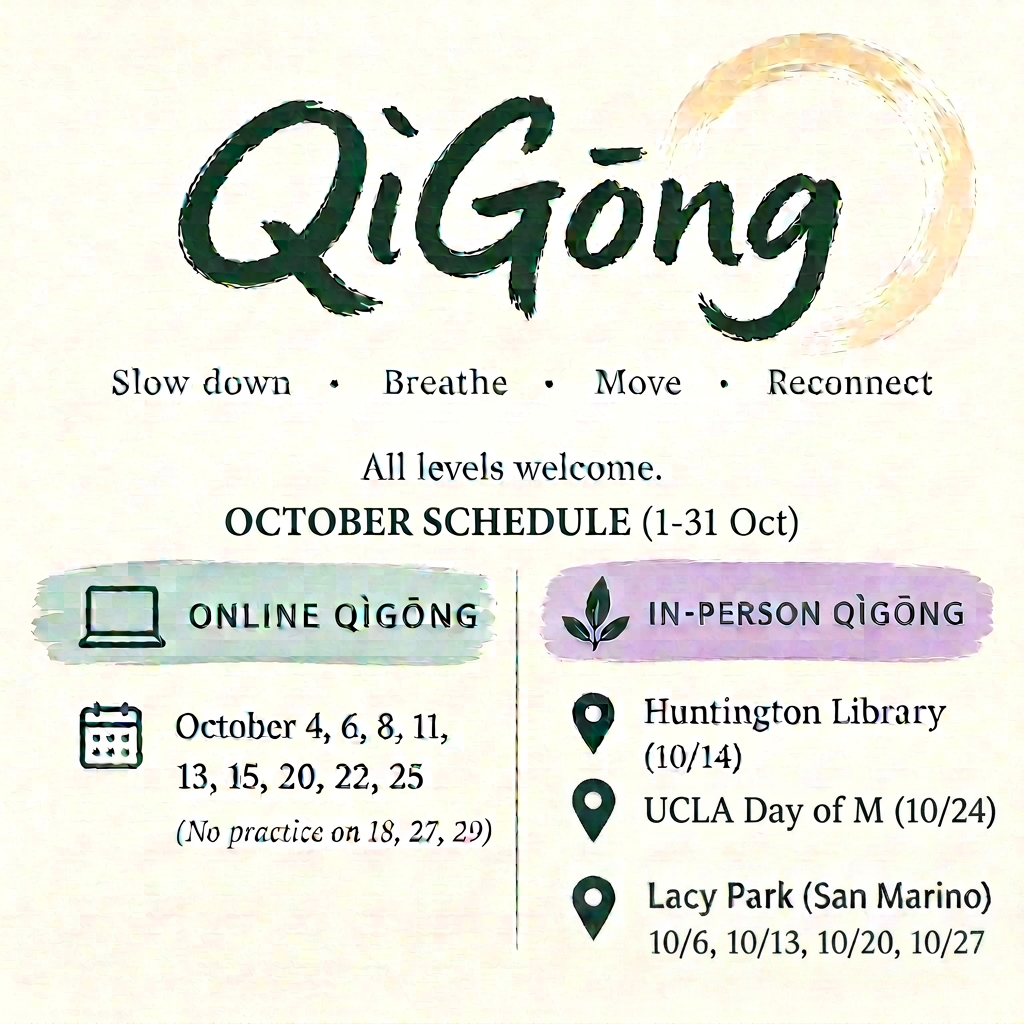
Qì Gōng: Online and In-Person

It was nourishing to practice together this morning with Debbie, Simone, Bonnie, and Karin.

Welcome Karin! Glad you joined for the first time!

From this morning, I heard reflections like “it was comforting, soothing, grounding” and connecting to moves in a way that felt “joyful and playful” even as people faced uncertainty.

My journey of healing from the mild traumatic brain injury continues. My brain still gets tired after an hour of reading, writing, and speaking with complex ideas.

Qì Gōng continues to be a big part of my rehab and essential as I enter this new mode of healing and working. I am grateful to my teachers the late Dr. Hu and to Paul Li, as well as my practice coach my dad and mom and the wild goose / dayan teaching community. Mindful movement has been good for getting the neural circuits connected and to get the parasympathetic system to be in charge.

I continue with qì gōng and walking mindfulness because it is healing to mindfully move together while in community and drawing from this tradition that is 1000s years old.

We are closing a chaotic March and are starting a new month this week.

Join us!

What is Qì Gōng?

Qì Gōng (chee-gong) is an ancient Chinese system of cultivating energy and awareness. Qì Gōng integrates gentle movement, mindful breathing, focused awareness, and aligned posture to harmonize mind, body, and spirit.

While Tai Chi is a martial art that incorporates Qì Gōng principles into choreographed movement sequences, Qì Gōng itself focuses more directly on cultivating internal energy and restoring balance through simpler, often stationary movements that are repeated in cycles.

What to Expect:

Movements inspired by nature, reflecting cycles of growth, rest, and renewal.

Grounding stances that connect you to the Earth, much like roots anchor a tree.

A welcoming environment open to all levels and all bodies—no prior experience needed.

Guidance to practice in a way that adapts to and centers your own body’s range of motion.

Where can I practice online?

Next practice time: Tue, March 31

WHEN: TUESDAYS, THURSDAYS, SUNDAYS

8 A.M. – 8:30 A.M PT (movement practice)

8:30 – 8:45 PT (reflection) optional

WHERE: For the live online sessions, click here or go to https://pitzer.zoom.us/j/513664738

BRING: Comfortable shoes, water, compassion, and cultural humility.

How much does it cost?

This practice is offered in the spirit of generosity. Donations or dana accepted for people and/or communities supporting genuine security and a culture of connection.

Suggested $5 – $20 per session.

  • If you have capacity, you are invited to consider donating to these efforts that support genuine security and a culture of connection or to a place of your choice:

Measure NDC (a.k.a. No Data Center) is scheduled for June 2. A “Yes” vote means you support a permanent, voter-protected ban on data centers in Monterey Park, CA. A dedicated campaign committee called Yes on Measure NDC has been formed to carry this effort across the finish line. Funds will go towards materials and canvassers in multiple languages. Community and neighbor driven effort.

https://www.gofundme.com/f/support-wilson-riles-home-care-and-recovery

https://www.gofundme.com/f/support-for-tricia

No one turned away due to lack of funds. People have offered poems, songs, cards, seeds, art. (K. Yep, PO Box 1313 Monterey Park, C 91754)

Your presence is always welcome.

SOME NEW IN-PERSON OPPORTUNITIES TO PRACTICE!

APRIL 1: Pitzer College

PEACE IS EVERY STEP: Mindful Walking in the Thích Nhất Hạnh Tradition

WHAT: A gentle, walking meditation inspired by the teachings of Thích Nhất Hạnh.
Slow down, breathe, and walk together in awareness as a community.

WHERE: Pitzer College, Claremont, CA 91711
McConnell Apron then walking loop around the mounds (as weather allows), Building 9 on the map

WHEN: 12:15 – 12:45 PM

Wednesdays
April 1
April 15
May 6

Come as you are. Come late. Leave early.

WHO: Open to everyone. No experience necessary.

BRING: Comfortable shoes, sunblock, sunhat, water, compassion, and cultural humility.

COST: Free

FACILITATED BY
Dr. Kathy Yep
Full Professor, Asian American Studies, Pitzer College
Faculty for ASAM 88: The Social Theory of Thích Nhất Hạnh

BACKGROUND

“Peace work is not a means. Each step we make should be peace.
Each step we make should be joy. Each step we make should be happiness.
We don’t need the future. Everything we want is right here in the present moment.”
— Thích Nhất Hạnh, Creating True Peace

Zen master Thích Nhất Hạnh co-founded Tiep Hien (the Order of Interbeing) during the American War in Vietnam in the 1960s. The Order of Interbeing organized community-led mutual aid amid militarism, forced displacement, human-made starvation, gender-based violence, environmental destruction, and collective grief.  Tending to the liminal space between heartbreak and hope, Tiep Hien (the Order of Interbeing) rooted their peace-making in the concepts of mindfulness and interconnectedness.

Thích Nhất Hạnh’s root temple is in Huế, Vietnam —the same city where Pitzer hosts one of our summer programs.

OPTIONAL RESOURCES

How to Walk — Thích Nhất Hạnh (4:29)

Basic Instructions for Walking Meditation — Sister Dang Nghiem (2:40)

Zen in Practice: Walking Meditation — Sister Sinh Nghiem (4:08)

Introduction to Waling Meditation – Sister Tu Ngheim (Eleni) (21m44s)

Interbeing: Precepts and Practices of an Applied Ecology – Joan Halifax and Marty Peale

APRIL 8: HUNTINGTON LIBRARY

EXPERIENCE THE ART OF QÌ GŌNG WITH KATHY YEP 

 Join Kathy Yep, professor of Asian American Studies at Pitzer College, as she guides visitors through a drop-in Qì Gōng session in the garden.

 Wednesdays April 8, May 13, and June 10, 2026 | 11:00–11:45 a.m.

Free with general admission to the Huntington Library
Meet at the Chinese Medicinal Garden 

Admission Tickets

Discover the transformative practice of Qì Gōng (chee-gong), an ancient Chinese system of cultivating energy and awareness. Qì Gōng integrates gentle movement, mindful breathing, focused awareness, and aligned posture to harmonize mind, body, and spirit. Whether you’re seeking dynamic motion or meditative stillness, Qì Gōng offers a pathway suited to everyone.

While Tai Chi is a martial art that incorporates Qì Gōng principles into choreographed movement sequences, Qì Gōng itself focuses more directly on cultivating internal energy and restoring balance through simpler, often stationary movements that are repeated in cycles.

Expect:
Movements inspired by nature, reflecting cycles of growth, rest, and renewal.

Grounding stances that connect you to the Earth, much like roots anchor a tree.

A welcoming environment open to all levels and all bodies—no prior experience needed

.Guidance to practice in a way that adapts to and centers your own body’s range of motion.

Kathy Yep brings over 30 years of Qì Gōng practice and teaching expertise. A tenured professor at the Claremont Colleges, she has trained extensively in Wild Goose Qì Gōng under the late Dr. Bingkun Hu and Paul Li in the Yang Meijun tradition. Yep also researches, publishes, and teaches about Qì Gōng in relation to public health and educational outcomes.

Please note: This is an educational session and not medical advice or treatment.

KEY DETAILS:
Bring comfortable shoes, water, and a compassionate mindset. 

This is a drop-in session.

Meet at the Chinese Medicinal Garden.

This event may be canceled in the event of rain or excessive heat.

APRIL 22, 29: Hermon Park

WHERE: 5566 Via Marisol, Los Angeles, CA 90042

near or in historic Lawn Bowling Club House depending on weather

WHEN: Wednesdays, April 22, 29

11 A.M. – 11:30 A.M PT (movement practice)

11:30 – 11:45 PT (reflection) optional

Come as you are. Come late. Leave early. All ages. Dogs and cats are welcome.

COST: Free

WHAT: Discover the transformative practice of Qì Gōng (chee-gong), an ancient Chinese system of cultivating energy and awareness. Qì Gōng integrates gentle movement, mindful breathing, focused awareness, and aligned posture to harmonize mind, body, and spirit. Whether you’re seeking dynamic motion or meditative stillness, Qì Gōng offers a pathway suited to everyone.

While Tai Chi is a martial art that incorporates Qì Gōng principles into choreographed movement sequences, Qì Gōng itself focuses more directly on cultivating internal energy and restoring balance through simpler, often stationary movements that are repeated in cycles.

EXPECT:
* Movements inspired by nature, reflecting cycles of growth, rest, and renewal.

* Grounding stances that connect you to the Earth, much like roots anchor a tree.

* A welcoming environment open to all levels and all bodies—no prior experience needed.

  • Guidance to practice in a way that adapts to and centers your own body’s range of motion.

BRING: Comfortable shoes, sunblock, sunhat, water, compassion, and cultural humility.

In collaboration with Art in the Park LA

Next practice: Thu Mar 26

Hello beloved practice community,

We had a meaningful practice this morning with Jasmine, TQ, Simone, Liz, and Aliyah– from what I recall and my brain is tired so take this with a grain of salt: of as Liz says “what I heard, what I experienced”: insights about relief, meeting yourself and things as they are while also having tools like “sweep,” suppleness to balance transitions, curiosity to what is unfolding, openness, laughter, and accompaniment. Thank you for the movement practice from the primordial set and your insights.

A gentle reminder we will not have practice until Thu March 26. This is short and sweet because brain is fatigued.

May your practices nourish and flourish until then. The next time we will see each other will be in the new season!

Be well,

Kathy

Schedule changes coming up

Hello and happy lunar new year! I hope you are well. No lunar new year post because navigating cognitive fatigue. Here’s to the fire horse!

We are starting a new month on Sunday! Thank you for practicing together for February. Your presence is always welcome. If you have capacity, donating to these gofundme is welcomed or to a place of your choice:

https://www.gofundme.com/f/support-wilson-riles-home-care-and-recovery

https://www.gofundme.com/f/support-for-tricia

Our last practice and reflection were powerful and humbling as we practiced tracing the meridians and then adapted to how we needed to move while rooted in qi gong principles.

Some themes as I recall that came up (brain is tired): staying connected with self and others, nourishing mercy in self and for others, casting aside childhood norms about feelings and feeling feelings as adults, sustaining communities where can unlearn and relearn.

We will have class per usual on Sundays, Tuesdays, and Thursdays except for the following days:

No class:

Sunday March 8, Tuesday March 10

Thu March 19, Sun 3/22 and Tue 3/24

The first day of spring is March 20! What do these last weeks of winter feel like and look like for you?

Be well,

Kathy

LIVE ONLINE DROP IN QÌ GŌNG: SPRING SEMESTER SCHEDULE

WHEN: TUESDAYS, THURSDAYS, SUNDAYS

8 A.M. – 8:30 A.M PT (movement practice)

8:30 – 8:45 PT (reflection) optional

WHERE: For the live online sessions, click here or go to https://pitzer.zoom.us/j/513664738

I was fortunate to start learning dayan/wild goose over 30 years ago.. Lately, I have been teaching small pieces of dayan/wild goose. Join us! This is a demo video of set 1.

The journey of healing from the mild traumatic brain injury continues. It has been 13 months since the car accident and about 9 months since I fell and hit my head after the accident. I am still doing rehab daily and hoping to get back to teaching, research, and life more fully. I still experience pain when I read, write, and think at the work level of a professor after an hour. Qì gōng and mindful walking have been grounding, healing, and connective.

I continue with qì gōng because it is nourishing. I find joy in moving mindfully with community and carrying forward this tradition of 1000+years in the the Yang Mei Jun lineage via the late Dr. Hu and Paul Li. My dad practices every day and he loves hearing about our practice on zoom.

Join us in practice! All abilities and bodies are welcome. No experience necessary. Offered in the spirit of generosity.

Donations accepted for community partner, Interfaith Movement for Human Integrity. No amount is too small or too big. All are welcome regardless of funds donated.  (Make offerings to where and how you wish for or food, water, medicine, medical care, shelter, clothes.)

Suggested donations: sliding scale $5- $20 per session. No one turned away for lack of funds.  

At the end of month donate directly to the organizations or send check or offerings to: K. Yep, P.O. Box 1313, Monterey Park, CA 91754 for the number of sessions you attended. People have sent poems, seeds, cards, quotes, art and offerings.

All levels are welcome. Bring open heart, cultural humility, and water. Come early or late. Leave early if needed.  As Liz says: “Come as you are.”

We are learning and practicing with a form that is over a 1000 years old. We are meeting the movements and the form rooted in a tradition with who we are and who we are becoming from our specific social locations. It is an invitation of continuity and accompanying our selves, each other, and all beings with relaxed awareness.

As Debbie says: “Connect to playfulness”. As Simone says “Receive it as care and release the struggle.” As Penny says: “Try different ways of moving — inside to out, outside to in, from the bones, from the muscle, from the air)

WHERE: For the live online sessions, click here or go to https://pitzer.zoom.us/j/513664738

JOIN THE EMAIL LIST : To receive updates and more information about qì gōng

follow kathyyep.com or click bottom right & hit subscribe

May we be well. May we be truly happy. May we be relieved of suffering.

HOLIDAY SCHEDULE & WINTER SOLSTICE

Our remaining practices for 2025: 12/16, 12/18, 12/21

We will resume Sunday, January 4, 2026

Winter Solstice: 12/21/25

By: Dawn Scott, devon hase, Yong Oh, and Kimi Mojica
“The Winter Solstice marks the turning point of the year — the longest night, followed by the gradual return of the light. Across cultures and traditions, this sacred moment invites reflection, renewal, and reconnection with the rhythms of nature and the cycles within us. Each winter, the world offers its oldest teaching: the turning of the light. The Solstice is both an outer and inner threshold — when darkness reaches its culmination and light begins its gradual return.

We learn that darkness is not the absence of light, but its fertile ground. Through this journey, we remember that awakening is never solitary — it unfolds in community, in nature, and in relationship. Together, we become lights in the dark for one another.

What Is the Winter Solstice?

The Winter Solstice is the turning point of the year — the moment when the sun pauses in its descent, and the longest night gives way to the slow return of light. In the Northern Hemisphere, it usually falls around December 21, marking the beginning of winter and symbolizing a time of stillness, reflection, and renewal. Across cultures and centuries, people have honored the Solstice as a sacred threshold: a moment to release the old, plant intentions for the new, and remember our deep connection to the cycles of nature.


It reminds us that darkness and light are not opposites, but partners in the rhythm of life — that rest and renewal, loss and growth, are all part of one living continuum. In the language of the Dharma, the Solstice mirrors the inner path of awakening: descending into stillness, meeting what is difficult with compassion, and emerging renewed in clarity and light.

The Solstice teaches that even in the darkest night, the light is already returning.

Each year, the Winter Solstice calls us to pause — to honor the dark, to rest deeply, and to listen for the light returning.

Amid the noise and urgency of modern life, it invites you to slow down, breathe, and reconnect with what’s timeless.In stillness, movement, and ritual, you’ll discover that darkness is not something to escape, but a teacher — a place of wisdom, creativity, and rebirth.

Why it matters now

(T)he world needs light-bearers — people who can hold presence amid change, who can listen deeply, and who remember our shared belonging with one another and the Earth. When we sit together on the longest night, we remember that the light has never truly left — it has only been waiting for us to turn toward it.

We live in a time of immense change, noise, and uncertainty. The solstice reminds us that stillness, not speed, brings renewal.

(R)emember what’s always been true:
● Wisdom arises from the dark. The very places we resist — loss, rest, grief, uncertainty — hold the seeds of transformation.
● We awaken together. The warmth of spiritual friendship lights our way through the unknown.
● Ritual restores meaning. In community, we reconnect with the larger cycles of life
● Nature is our mirror. Just as the light returns after the longest night, so too can clarity, joy, and compassion return to the heart.”

WINTER SOLSTICE AND TRADITIONAL CHINESE MEDICINE (TCM)

As winter comes closer, the days get shorter and the air gets colder. The earth invites us to slow down, rest, and reflect. In TCM, winter is a season of stillness and nourishment—a time to replenish your body and mind. TCM offers valuable insights to help us align with the rhythms of the season, maintain balance, and reflect.

In TCM, winter is a calm and quiet season. It teaches us to save our energy and reflect. In TCM, winter is connected to water and to the kidneys and bladder.

These organs are considered the body’s energetic reservoirs, storing vital energy (Qi) to support health and longevity. Just as animals hibernate and trees conserve energy in the winter, humans are encouraged to follow suit by focusing on rest, warmth, and nourishment.

We practice for the benefit of ourselves and all beings so all beings may be free. Sending loving kindness.