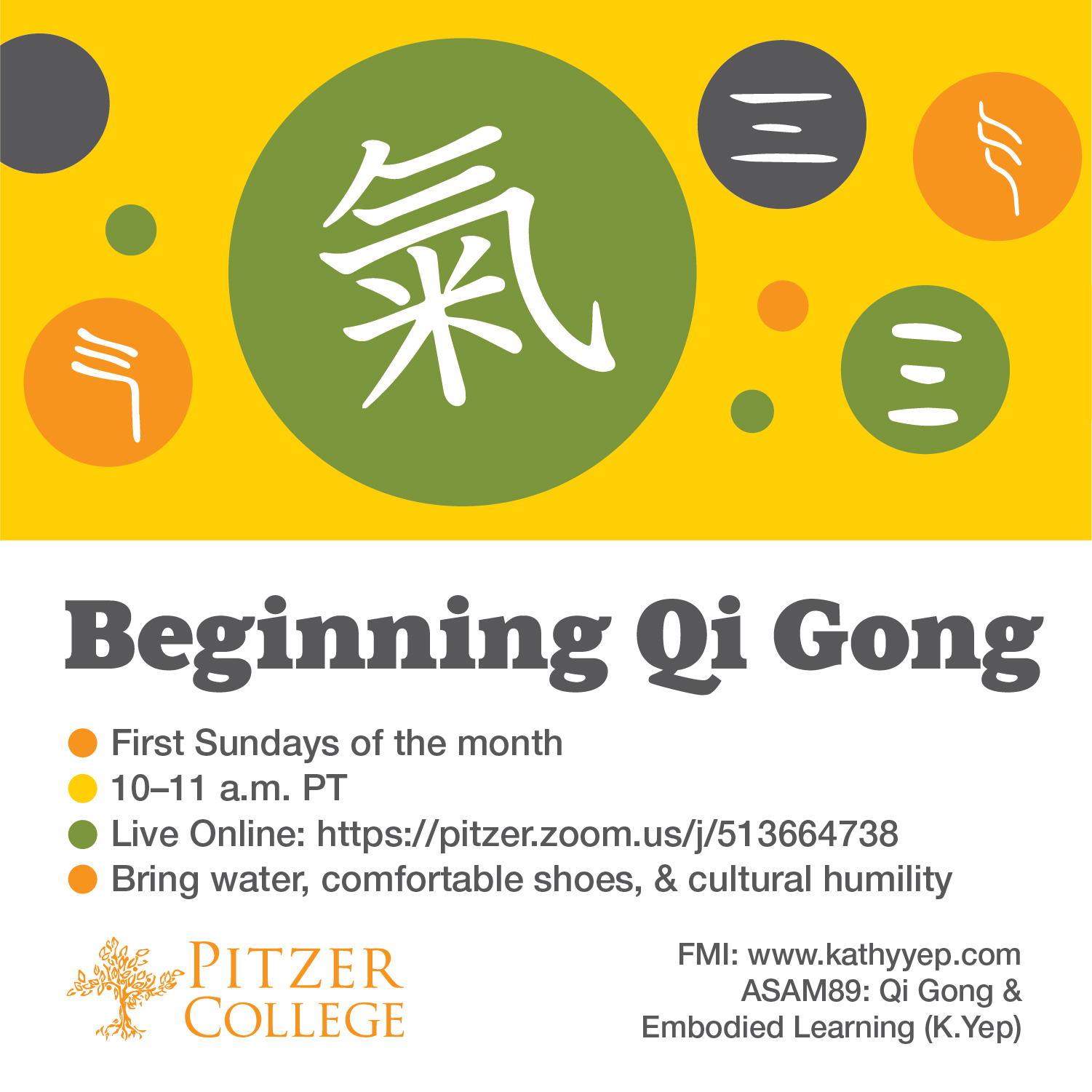
Drop-in, live online da yan qì gōng. Offered in the spirit of generosity. Donations accepted for community partner: interfaith movement for human integrity. #First Sundays

Drop-in, live online da yan qì gōng. Offered in the spirit of generosity. Donations accepted for community partner: interfaith movement for human integrity. #First Sundays


When I had cancer, I started learning dayan (wild goose) qì gōng from Paul Li and Dr Bungkun Hu. In this last decade, I have been teaching qì gōng to foster the relaxation response in the face of challenges and/or systemic inequities. Currently, I am researching qì to address educational inequities for students.
Join me this Friday, 5/19: 12 – 1 pm PT for a free online qì gōng workshop through AARP California for APIDA Heritage Month. Registration required.
Open to all. No experience necessary. Wear comfortable shoes and clothes. Bring water and cultural humility.
“For Asian American & Pacific Islander (AAPI) Heritage Month this May, join us for an opportunity to learn and celebrate the community’s tradition with regards to health and wellness: qigong (pronounced chee-gung). Professor Kathy Yep, a certified mindfulness facilitator and a practitioner of Dayan Qì Gōng, will provide a demonstration of Qì Gōng’s gentle, flowing movements and breathing technique. Qì Gōng is gentle and easy to learn and is suitable for all ages and physical conditions.Qì Gōng, a meditative practice of gentle stretching, movement and breathing, has shown the potential to lower stress and anxiety. Please consult your physician before beginning any new exercise regimen.
Please do not opt out of event-related emails, as you will be emailed a link to join the class via Zoom prior to the event.
FREE, ONLINE: REGISTER HERE
For more information, contact AARP California at caaarp@aarp.org.

Excited and humbled that my “ASAM89: Qì Gōng and Embodied Learning” class will learn from master teacher Phoeun You. My students/co-learners are learning and facilitating some foundational Qì Gōng moves. Drawing from Phoeun’s decades-long experience teaching and counseling, he will coach them on facilitating with compassion, reflection, and awareness in the context of social inequities.
Title: “Teaching Breathing and Listening”
Zoom Session 1: Tools and guiding principles
Zoom Session 2: Reflecting on teaching and Q & A
Some student posts after session 1:
“When I started to reflect on the conversation with Phoeun I immediately thought of his contagious personality. Usually it is really hard to feel connected through a zoom call, but I genuinely felt everything he said, and wanted to talk to him more. Also, his ability to extract a lesson from seemingly simple daily occurrences. The story he told about the taxi driver up-charging him really stuck with me. The capacity he has to stay present and think about his emotions in relation to his actions is so inspiring. The reminder to breathe and take a step to think about your feelings is so invaluable.”
“As I reflect on our conversation with Phoeun, I really appreciate the kindness that radiates from him. Even through zoom, it is obvious that he is extremely caring of the people he shares space with. For example, after we did our opening circle, he requested that some of our classmates changed locations so he could see them during our conversation. This small request indicates that Phoeun is mindful of the space he takes and respects the space that other presences require. As a student who is very hesitant when participating in class and who sometimes has trouble navigating large group settings because I become self conscious about my presence, I especially appreciated this moment because it showed that everyone is welcome in the space, even when passively participating just by being present.”
“As I reflect on our conversation, the image of butterflies flying in the blue sky comes to mind. I see Phoeun as a butterfly, transcending space and joining our class as a member. A main message that stuck with me is the importance of responding to situations instead of reacting to them. I find that often I react to situations with strong emotions that tend to fuel negative feelings. Since our conversation with Phoeun, I have practiced implementing responding to situations instead of reacting to them. For example, my car’s air conditioning broke, and I had an hour long drive ahead of me in the hot sun. Instead of speeding recklessly, I responded by taking deep breathes, and lowering the windows of the car. I took sips of water, listened to music, and tried focusing on the wind. I eventually made it home safe and sound. Thank you Phoeun for helping me get through challenging times with your teachings.”