
WHAT: Free Drop-in practice of mindfulness and qi gong (facilitator: K.Yep)
WHEN: 12:30 – 1 p.m., 1st and 3rd Tuesdays, starting February 2019
WHAT IS HEALING JUSTICE? “Conscious of systemic suffering and injustices, we work to create a more just, peaceful, and sustainable world. We promise, for the benefit of all, to practice self-care, mindfulness, healing, and joy. We vow to not burn out.” (Mushim Patricia Ikeda 2016)
WHO: Free and open to the public, no experience necessary.
WHERE:
Room 208 of Gold Student Center, Pitzer
https://mypz.pitzer.edu/netcommunity/view.image?Id=1148
WHAT TO BRING:
1. Intercultural understanding frame
2. Water
3. Compassion
4. Comfortable shoes
Scholarship suggests that mindfulness:
* Decreases stress (Shapiro et. al. 2005; Zeidan et. al. 2011)
* Impacts the brain (Davidson et. al. 2003; Luders et.al. 2009)
* Impacts implicit bias or compassion (Burgess et. al. 2017; Jazaleri, et. al. 2012; Leuke & Gibson 2015; Tincher et. al. 2016)
*Impacts immune markers (Hazel 2011; Jacobs et. al. 2011; Morgan et. al. 2014)
* Impacts executive functions (Teper et. al. 2013)
“Oppression(s) do not operate on merely an intellectual level. It is painful and embodied. Conversations about oppressions are hard, if they are real. We must unlearn internalized oppression(s) at the very cells of our being. While we condemn oppression(s), we do violence to ourselves and others if we don’t bring compassion to our experience. Mindfulness teaches us compassion for self and others.” (Beth Berila 2016)
FMI: www. kathyyep..com
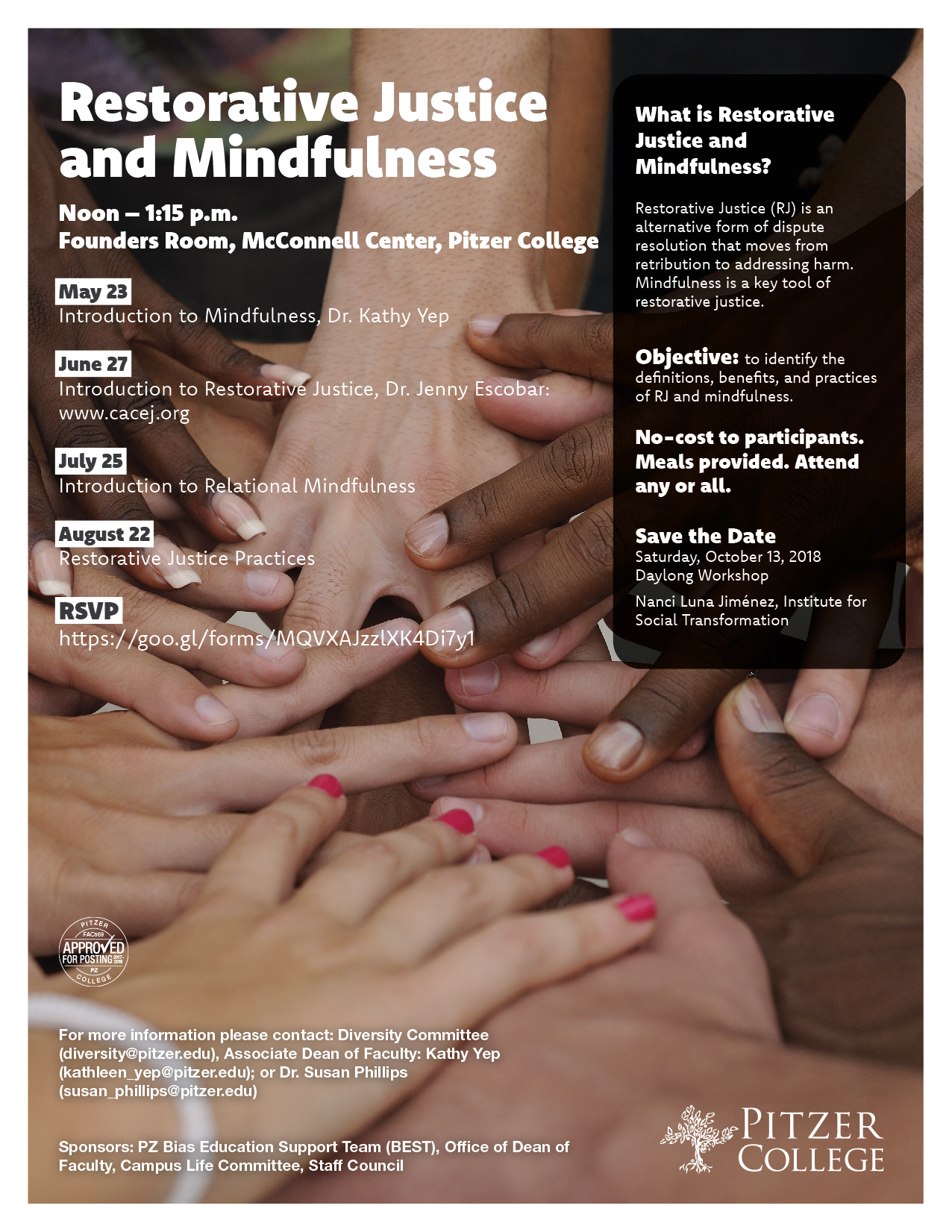
WHAT: Transformational Relationships with Institute for Social Transformation
No-cost to PZ participants. Breakfast and lunch provided.
WHO: Open to Pitzer College faculty, staff, students, and community partners.
WHEN: 8:00 a.m. – 5 p.m. (to be confirmed)
WHERE: Multipurpose Room, Gold Student Center, Pitzer College (to be confirmed)
We appreciate your interest. Please note that filling out the survey does not guarantee a spot in the workshop. We are taking into consideration representation from different sectors of the campus and attendance at previous events for the 50 spots. We hope to continue to provide more programming to support your interest in professional development opportunities like these.
Kindly, RSVP by 9/25/18
FMI: Dr. Kathy Yep, Associate Dean of Faculty, Kathleen_yep@pitzer.edu
SPONSORED BY: Diversity Committee, Campus Life Committee, and Office of the Dean of Faculty
RECOMMENDED READINGS: The following readings are recommended (but not required) before the daylong workshop:
* WEISSGLASS, CONSTRUCTIVIST LISTENING:
Click to access Constructivist-Listening-for-Empowerment-and-Change.pdf
WHAT: Free Drop-in practice of mindfulness and qi gong (facilitator: K.Yep)
WHEN: 12:30 – 1 p.m., 1st and 3rd Tuesdays
WHAT IS HEALING JUSTICE? “Conscious of systemic suffering and injustices, we work to create a more just, peaceful, and sustainable world. We promise, for the benefit of all, to practice self-care, mindfulness, healing, and joy. We vow to not burn out.” (Mushim Patricia Ikeda 2016)
WHO: Free and open to the public, no experience necessary.
WHERE:
Room 208 of Gold Student Center, Pitzer
https://mypz.pitzer.edu/netcommunity/view.image?Id=1148
WHAT TO BRING:
1. Intercultural understanding frame
2. Water
3. Compassion
4. Comfortable shoes
Scholarship suggests that mindfulness:
* Decreases stress (Shapiro et. al. 2005; Zeidan et. al. 2011)
* Impacts the brain (Davidson et. al. 2003; Luders et.al. 2009)
* Impacts implicit bias or compassion (Burgess et. al. 2017; Jazaleri, et. al. 2012; Leuke & Gibson 2015; Tincher et. al. 2016)
*Impacts immune markers (Hazel 2011; Jacobs et. al. 2011; Morgan et. al. 2014)
* Impacts executive functions (Teper et. al. 2013)
“Oppression(s) do not operate on merely an intellectual level. It is painful and embodied. Conversations about oppressions are hard, if they are real. We must unlearn internalized oppression(s) at the very cells of our being. While we condemn oppression(s), we do violence to ourselves and others if we don’t bring compassion to our experience. Mindfulness teaches us compassion for self and others.” (Beth Berila 2016)
FMI: www. kathyyep..com
 Dr. Kathy Yep