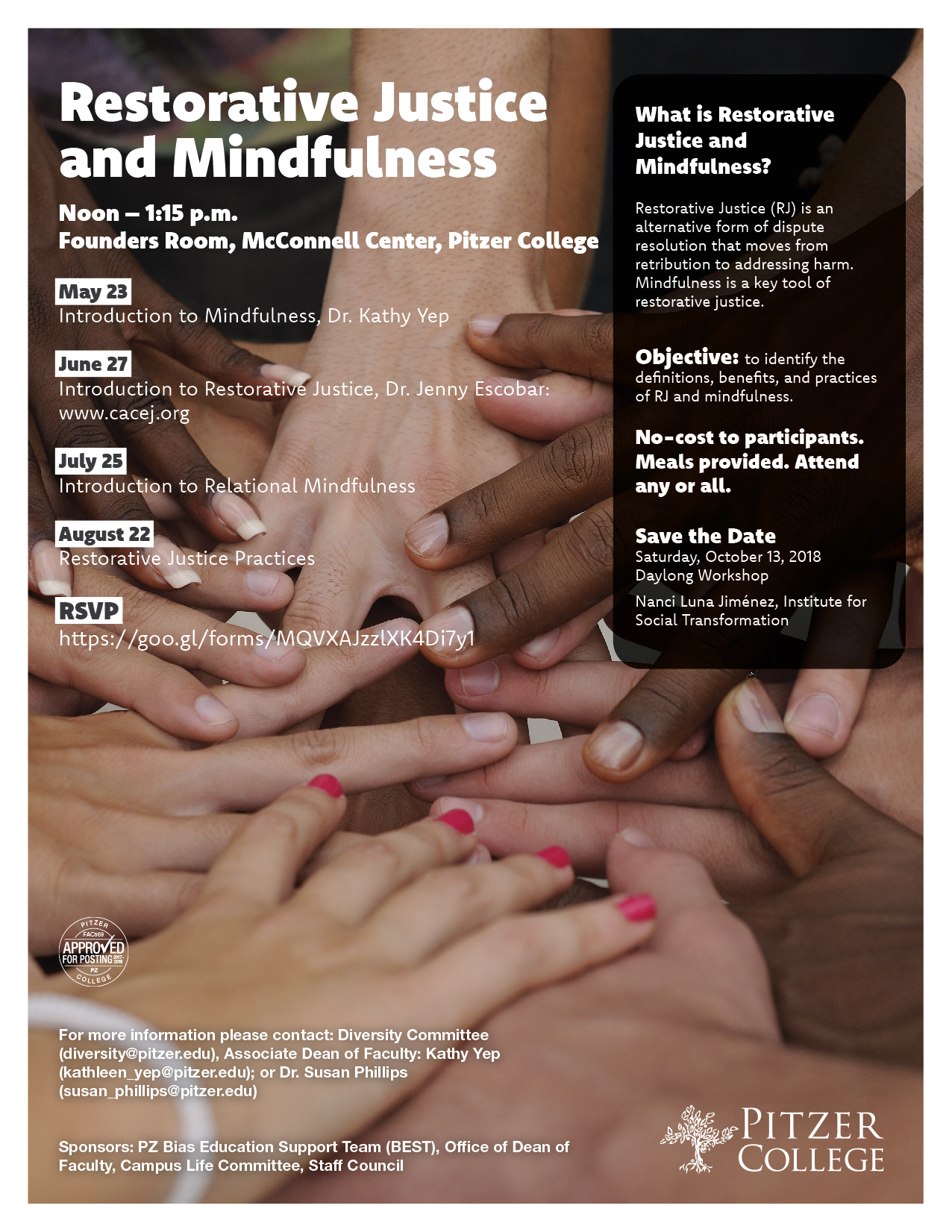

WHAT: Free Drop-in practice of mindfulness and qi gong (facilitator: K.Yep)
WHEN: 12:30 – 1 p.m., 1st and 3rd Tuesdays, starting February 2019
WHAT IS HEALING JUSTICE? “Conscious of systemic suffering and injustices, we work to create a more just, peaceful, and sustainable world. We promise, for the benefit of all, to practice self-care, mindfulness, healing, and joy. We vow to not burn out.” (Mushim Patricia Ikeda 2016)
WHO: Free and open to the public, no experience necessary.
WHERE:
Room 208 of Gold Student Center, Pitzer
https://mypz.pitzer.edu/netcommunity/view.image?Id=1148
WHAT TO BRING:
1. Intercultural understanding frame
2. Water
3. Compassion
4. Comfortable shoes
Scholarship suggests that mindfulness:
* Decreases stress (Shapiro et. al. 2005; Zeidan et. al. 2011)
* Impacts the brain (Davidson et. al. 2003; Luders et.al. 2009)
* Impacts implicit bias or compassion (Burgess et. al. 2017; Jazaleri, et. al. 2012; Leuke & Gibson 2015; Tincher et. al. 2016)
*Impacts immune markers (Hazel 2011; Jacobs et. al. 2011; Morgan et. al. 2014)
* Impacts executive functions (Teper et. al. 2013)
“Oppression(s) do not operate on merely an intellectual level. It is painful and embodied. Conversations about oppressions are hard, if they are real. We must unlearn internalized oppression(s) at the very cells of our being. While we condemn oppression(s), we do violence to ourselves and others if we don’t bring compassion to our experience. Mindfulness teaches us compassion for self and others.” (Beth Berila 2016)
FMI: www. kathyyep..com
WHAT: Transformational Relationships with Institute for Social Transformation
No-cost to PZ participants. Breakfast and lunch provided.
WHO: Open to Pitzer College faculty, staff, students, and community partners.
WHEN: 8:00 a.m. – 5 p.m. (to be confirmed)
WHERE: Multipurpose Room, Gold Student Center, Pitzer College (to be confirmed)
We appreciate your interest. Please note that filling out the survey does not guarantee a spot in the workshop. We are taking into consideration representation from different sectors of the campus and attendance at previous events for the 50 spots. We hope to continue to provide more programming to support your interest in professional development opportunities like these.
Kindly, RSVP by 9/25/18
FMI: Dr. Kathy Yep, Associate Dean of Faculty, Kathleen_yep@pitzer.edu
SPONSORED BY: Diversity Committee, Campus Life Committee, and Office of the Dean of Faculty
RECOMMENDED READINGS: The following readings are recommended (but not required) before the daylong workshop:
* WEISSGLASS, CONSTRUCTIVIST LISTENING:
Click to access Constructivist-Listening-for-Empowerment-and-Change.pdf
WHAT: Free Drop-in practice of mindfulness and qi gong (facilitator: K.Yep)
WHEN: 12:30 – 1 p.m., 1st and 3rd Tuesdays
WHAT IS HEALING JUSTICE? “Conscious of systemic suffering and injustices, we work to create a more just, peaceful, and sustainable world. We promise, for the benefit of all, to practice self-care, mindfulness, healing, and joy. We vow to not burn out.” (Mushim Patricia Ikeda 2016)
WHO: Free and open to the public, no experience necessary.
WHERE:
Room 208 of Gold Student Center, Pitzer
https://mypz.pitzer.edu/netcommunity/view.image?Id=1148
WHAT TO BRING:
1. Intercultural understanding frame
2. Water
3. Compassion
4. Comfortable shoes
Scholarship suggests that mindfulness:
* Decreases stress (Shapiro et. al. 2005; Zeidan et. al. 2011)
* Impacts the brain (Davidson et. al. 2003; Luders et.al. 2009)
* Impacts implicit bias or compassion (Burgess et. al. 2017; Jazaleri, et. al. 2012; Leuke & Gibson 2015; Tincher et. al. 2016)
*Impacts immune markers (Hazel 2011; Jacobs et. al. 2011; Morgan et. al. 2014)
* Impacts executive functions (Teper et. al. 2013)
“Oppression(s) do not operate on merely an intellectual level. It is painful and embodied. Conversations about oppressions are hard, if they are real. We must unlearn internalized oppression(s) at the very cells of our being. While we condemn oppression(s), we do violence to ourselves and others if we don’t bring compassion to our experience. Mindfulness teaches us compassion for self and others.” (Beth Berila 2016)
FMI: www. kathyyep..com
WHAT: Free drop-in practice of mindfulness and qi gong
WHEN: 12:30 – 1 p.m., 1st and 3rd Tuesdays
WHO: Free and open to the public, no experience necessary.
WHERE:
Living Room, McConnell, Pitzer College (Bdlg 9 on map)
Free parking: Visitor Spots in Holden and East Mesa Parking (15 and 16 on map)
Campus Map:
https://mypz.pitzer.edu/netcommunity/view.image?Id=1148
WHAT TO BRING:
1. Intercultural understanding frame
2. Water
3. Compassion
4. Comfortable shoes
Scholarship suggests that mindfulness:
*Impacts immune markers (Hazel 2011; Jacobs et. al. 2011; Morgan et. al. 2014)
* Impacts executive functions (Teper et. al. 2013)
* Decreases stress (Krasner et al., 2009) or pain (Zeidan et. al. 2011)
* Impacts the brain (Davidson et. al. 2003; Luders et.al. 2009)
* Impacts compassion (Jazaleri, et. al. 2012; Neff and Germer 2013)
* Impacts implicit bias (Burgess et. al. 2017; Kang, Gray, & Dovidio, 2014; Leuke & Gibson 2015; Tincher et. al. 2016)
WHAT IS MINDFULNESS?
“Mindfulness is when you are truly there, mind and body together. You breathe in and out mindfully, you bring your mind back to your body, and you are there. When your mind is there with your body, you are established in the present moment. Then you can recognize the many conditions of happiness that are in you and around you, and happiness just comes naturally. ” (Thich Nhat Hanh)
“Conscious of systemic suffering and injustices, we work to create a more just, peaceful, and sustainable world. We promise, for the benefit of all, to practice self-care, mindfulness, healing, and joy. We vow to not burn out.” (Mushim Patricia Ikeda 2016)
“Oppression(s) do not operate on merely an intellectual level. It is painful and embodied. Conversations about oppressions are hard, if they are real. We must unlearn internalized oppression(s) at the very cells of our being. While we condemn oppression(s), we do violence to ourselves and others if we don’t bring compassion to our experience. Mindfulness teaches us compassion for self and others.” (Beth Berila 2016)
“I think our notions of what counts as radical have changed over time. And I think that now we’re thinking deeply about the connection between interior life and what happens in the social world. We have to imagine the kind of society we want to inhabit. We can’t simply assume that somehow, magically, we’re going to create a new society in which there will be new human beings. No, we have to begin that process of creating the society we want to inhabit right now.” (Angela Davis in conversation with Fania Davis, 2016)
“Reconciliation is increasingly understood as an umbrella-term for an overall process which includes the search for truth, justice and forgiveness with the past is necessary for successful transitions from conflict, resentment and tension to peace and connectedness. …Whereas the role of courts is to judge the guilt or innocence of the alleged perpetrator, the focus of truth commissions is placed on the victims and their individual experiences.” (ICRC)
“If we want to grow as teachers — we must do something alien to academic culture: we must talk to each other about our inner lives — risky stuff in a profession that fears the personal and seeks safety in the technical, the distant, the abstract.”
― Parker J. Palmer, The Courage to Teach: Exploring the Inner Landscape of a Teacher′s Life
 Dr. Kathy Yep